Back Range Light Tower
Recognized Federal Heritage Building
New London, Prince Edward Island
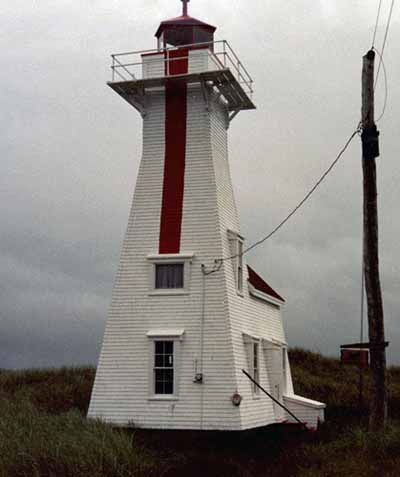
General view
(© Department of Transport / Ministère des Transports, 1986.)
Address :
New London, Prince Edward Island
Recognition Statute:
Treasury Board Policy on Management of Real Property
Designation Date:
1991-01-25
Dates:
-
1876 to 1876
(Construction)
Event, Person, Organization:
-
Department of Marine and Fisheries
(Architect)
Custodian:
Fisheries and Oceans Canada
FHBRO Report Reference:
89-214
DFRP Number:
81076 00
Description of Historic Place
The attractive Back Range Light Tower with an attached dwelling is located on the flat, coastal landscape of New London. It is comprised of a square tapered, medium-height tower attached to a one-storey, gable-roofed structure. These are clad in white-painted wood shingles with red trim around multi-pane wood windows and the doors. A brick chimney projects from the roof of the dwelling and a red-painted steel and glass, multi-sided lantern crowns the tower. A vertical stripe daymark in red is visible on the tower’s seaside façade. The designation is confined to the footprint of the building.
Heritage Value
The Back Range Light Tower is a Recognized Federal Heritage Building because of its historical associations, and its architectural and environmental values.
Historical Value
The Back Range Light Tower is associated with the post-Confederation building campaigns to improve maritime safety by building an extensive network of coastal lights. The inclusion of dwellings at the light towers reflected the importance of maintaining the lights at these locations.
Architectural Value
The Back Range Light Tower is valued for its very good aesthetic design. The medium-height, square tapered light tower, attached to a dwelling, is a picturesque example of a design popular in Prince Edward Island. Constructed of wood, the light tower exhibits the simplified and smooth appearance typical of marine buildings. The good functional layout of the building reflected departmental guidelines in providing ample room for the keeper and his family. Displaying good craftsmanship, the extended top and superimposed gallery are distinct features of the design.
Environmental Value
The Back Range Light Tower maintains an unchanged relationship to its site and is compatible with the picturesque maritime character of its remote coastal setting. The light tower functions as an important marker of its associated remote environment and is well known in the area.
Sources: Lighttower, Rear Range, New London Prince Edward Island, Federal Heritage Buildings Review Office, Building Report, 89-214; Lighttower, New London, Prince Edward Island, Heritage Character Statement, 89-214.
Character-Defining Elements
The character-defining elements of the Back Range Light Tower should be respected.
Its good aesthetic and functional design and good craftsmanship and materials, for example: the rectangular footprint and the massing, which is comprised of a square, tapered medium-height tower smoothly joined to the tapered sides of a one-storey structure with a shingled gable roof; the wood frame construction; the wood shingle siding, the superimposed wood bracketed gallery, cornice and the cross-braced guardrail; the multi-pane wood sash windows and door with distinctive projecting heads; the metal railings; the colour scheme; the surviving significant features and finishes of the interior.
The manner in which the Back Range Light Tower maintains an unchanged relationship to its site, is compatible with the picturesque maritime character of its coastal setting, and is a well-known landmark within the area, as evidenced by: its ongoing relationship to the flat, coastal landscape; its overall attractive scale, massing, design and materials, which is compatible with the picturesque coastal surroundings; its visibility from both land and water in the area, and its role as an important marker, which makes it a local landmark.
Heritage Character Statement
Disclaimer -
The heritage character statement was developed by FHBRO to explain the reasons for the designation of a federal heritage building and what it is about the building that makes it significant (the heritage character). It is a key reference document for anyone involved in planning interventions to federal heritage buildings and is used by FHBRO in their review of interventions.
The lighttower at New London was constructed in 1876. It was designed by the Department of Marine and Fisheries. Alterations include replacement of the wood cross- braced guardrail and brackets and replacement of the roofing. The building is currently a fully automated lighttower. The Canadian Coast Guard is the custodian. See FHBRO Building Report 89-214.
Reasons For Designation
The lighttower was designated Recognized because of its architectural importance and environmental significance, and also for its historical associations.
The simple and attractive design of the square tapered lighttower attached to a dwelling is a picturesque example of the lighttower type. The wooden lighttower is integrated with the dwelling in a smooth, simplified and sleek manner. The extended top and super-imposed gallery are distinct features of the design. The lay-out of this tower reflected departmental guidelines in providing ample room for the keeper and his family.
The scale and silhouette of the lighttower is compatible with the associated flat, coastal landscape. The lighttower functions as an important marker of the associated remote coastal environment. The building is well known in its locale and contributes to the maritime character of the site.
The lighttower is associated with post-Confederation building campaigns to improve maritime safety by building an extensive network of coastal lights. The inclusion of a dwelling at the lighttower reflects the importance of maintaining the light at this location.
Character Defining Elements
The heritage character of the New London lighttower resides in its overall form, profile, construction materials, architectural details, and site relationships.
The massing of the lighttower is comprised of a square, tapered medium-height tower smoothly joined to the tapered sides of a one storey gable-roofed structure. The footprint is a rectangular shape. The prominent chimney, the gallery guardrail and lantern as well as the projecting door and window heads contribute to the picturesque profile and should be maintained. The lantern is a prominent feature, appropriately proportioned to the tower, contributing to the sturdy and durable appearance.
The contrast of the simple details of the wood shingle siding with the smooth, larger-scaled wood detailing of the bracketed cornice and gallery guardrails contributes to the picturesque character. These contrasts create the main textural and material contrasts. The super-imposed wood bracketed gallery and cross-braced guardrail wrap around the tower which is framed above the guardrail height. The metal railings and bracket support design has a simple utilitarian character which adds textural detail and should be maintained. The metal and glass detailing of the lantern is expressive of the industrial character of this component. The exterior materials, siding and metalwork would benefit from an ongoing maintenance program.
The current roofing of the dwelling is asphalt shingles having a smoother, modern appearance which reduces the heritage character. At the end of its life, installing a wood shingle roof should be considered as it would improve the heritage character.
The multi-paned wood sash windows are sympathetic to the heritage character, and should be maintained.
Surviving features and finishes of the original interiors should be documented and maintained.
The open, undeveloped site upon which the lighttower has been placed underscores the utilitarian aspect of the design and function, and it should be maintained. The lighttower is well known, and functions as an important landmark both from land and sea-side.