Abbot Pass Refuge Cabin National Historic Site of Canada
Banff National Park of Canada, Alberta
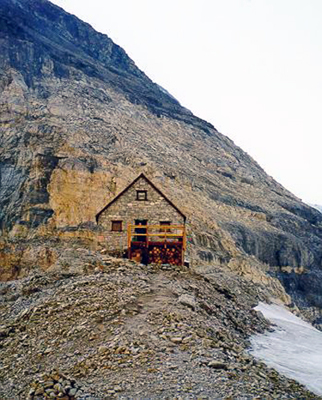
Showing the picturesque site
© Parks Canada | Parcs Canada, 2011.
Address :
Abbot Pass, Banff National Park of Canada, Alberta
Recognition Statute:
Historic Sites and Monuments Act (R.S.C., 1985, c. H-4)
Designation Date:
1992-11-06
Dates:
-
1922 to 1922
(Construction)
-
2022 to 2022
(Demolition)
Other Name(s):
-
Abbot Pass Refuge Cabin
(Designation Name)
-
Abbot Hut
(Other Name)
-
ABBOT PASS HUT
(Plaque name)
Research Report Number:
1992-OB-04 Nov; 1992-SUA; 2023-13; 2024-40
Plaque(s)
Existing plaque: Plaque erected at the site in front of the cabin. The plaque was retained on site on its original stone wall mount wall after deconstruction in 2022. Banff National Park of Canada, Alberta
Built in 1922, this sturdy shelter is a unique and enduring monument to the Swiss guides, who first came to the Rocky Mountains in 1897 under the auspices of the Canadian Pacific Railway. It was patterned on examples in the Swiss Alps. All materials, apart from the stone, were carried by pack horses past the Lower Victoria Glacier, then by the guides to the pass summit. Never again was such an arduous feat undertaken in the national parks. The shelter has served as a high-altitude base for generations of climbers, here in the cradle of Canadian mountaineering.
Description of Historic Place
Abbot Pass Refuge Cabin National Historic Site of Canada was a high altitude alpine shelter in Abbot Pass, a col between Mounts Lefroy and Victoria on the continental divide on the border between Banff and Yoho National Parks. Constructed in the Rustic Design tradition, it’s simple rectangular form and unadorned stone construction spoke to the rigors of its high altitude setting. The cabin was operated by the Alpine Club of Canada as a shelter for mountaineers. In June 2022 the cabin was largely deconstructed due to site erosion. The designation comprises the site originally occupied by the rustic stone hut.
Heritage Value
Abbot Pass Refuge Cabin was designated a national historic site in 1992. This designation was reviewed in 2024. It is recognized because:
• the rustic stone hut that once stood here was built by the Canadian Pacific Railway in 1922 to provide refuge for hikers and mountaineers. The structure was an iconic destination for outdoor recreationists from its opening in 1923 to its closure in 2018. Located in a dynamic mountain environment vulnerable to the effects of climate change, erosion processes on the slope led to the hut’s instability, forcing its demolition in 2022;
• Abbot Pass has long been associated with outdoor recreation and backcountry use in the Rocky Mountain national parks. Since the 1890s, mountaineers have used the pass as part of ascents of Mount Lefroy or Mount Victoria and hikers have set the pass as a goal for day trips or overnight excursions using the hut as a base and linking other mountain passes and surrounding lakes and valleys; key roles were played by the Canadian Pacific Railway, National Parks, and the Alpine Club of Canada in facilitating the long history of recreation in the pass;
• hikers and mountaineers have been drawn to Abbot Pass and the hut that was once here for its connections with the early history of Western European mountaineering tradition in Canada’s Rocky Mountains, and the achievement of reaching the high elevation location is associated with Western ideals of the sublime and related aesthetic and spiritual experiences.
The heritage value of this site resides in its physical expression of rustic design as well as in its traditional use through the years by visitors to the park. Built under the sponsorship of the Canadian Pacific Railway in 1922, it was acquired by the Parks Branch in 1968 and restored in 1973. Since 1985, the hut has been maintained and operated by the Alpine Club of Canada. More recently, rockfalls and gradual permafrost thaw caused slope instability and building damage. By 2016 increasing erosion necessitated stabilization work and in 2018 the cabin closed to visitors. Masonry cracks had developed by 2021, and in June 2022 Abbot Pass Refuge Cabin was deconstructed.
Source: Historic Sites and Monuments Board of Canada, Minutes, November 1992, June 2023 and December 2024.
Character-Defining Elements
Key elements contributing to the heritage value of this site include:
picturesque site in a barren and remote mountain pass above the tree line; the harmony of the setting, the building's siting, nestled in the contours of the surrounding terrain; its viewplanes along Abbot Pass and to trails from Banff and Yoho National Parks; its use as a shelter by the public, particularly mountaineers.