Forges du Saint-Maurice National Historic Site of Canada
Trois-Rivières, Quebec
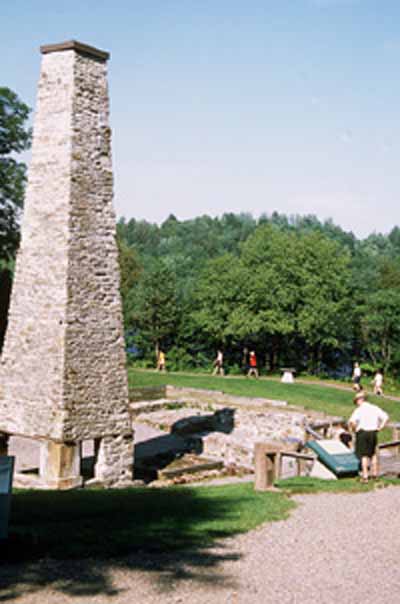
General view
© Parks Canada Agency / Agence Parcs Canada, E. Kedl, 2002.
Address :
10000 des Forges Boulevard, Trois-Rivières, Quebec
Recognition Statute:
Historic Sites and Monuments Act (R.S.C., 1985, c. H-4)
Designation Date:
1919-10-28
Dates:
-
1730 to 1730
(Construction)
Event, Person, Organization:
-
Sieur François Poulin de Francheville
(Architect)
Other Name(s):
-
Forges du Saint-Maurice
(Designation Name)
Research Report Number:
1965-021
DFRP Number:
06475 00
Plaque(s)
Plaque Removed: In the vaults of the Grande Maison (1988) 10000 des Forges Boulevard, Trois-Rivières, Quebec
The founding of les Forges du Saint-Maurice in 1730 marked the beginnings of Canada's iron industry and led to the creation of the country's first industrial community. Built near a source of iron ore and served by abundant water power, the enterprise grew around a blast furnace and two forges. In the early years, les Forges turned out iron for shipyards and royal arsenals. Later, production responded to the domestic needs of the country, including the building of railways. The complex shut down in 1883, after more than 150 years of operation.
Original Plaque: In the vaults of the Grande Maison 10000 des Forges Boulevard, Trois-Rivières, Quebec
THESE FORGES, ESTABLISHED IN 1730, BY POULIN DE FRANCHEVILLE, WERE THE FOREMOST INDUSTRY UNDER THE FRENCH REGIME AND CONTINUED IN OPERATION UNTIL 1880.
Description of Historic Place
Forges du Saint-Maurice National Historic Site of Canada is located fifteen kilometres north of the centre of Trois-Rivières, Quebec, on the banks of a stream that flows into the Saint-Maurice River. It is a cultural landscape that contains remnants of Canada’s earliest industrial community. The site has been redeveloped for historical interpretation by Parks Canada Agency. The designation refers to the landscape and its historic resources that date from the operation of Forges du Saint-Maurice in the 18th and 19th centuries.
Heritage Value
Forges du Saint-Maurice was designated a national historic site of Canada in 1920 because: established in 1730, Forges du Saint-Maurice was the principal industry under the French Regime; the founding of Forges du Saint-Maurice marked the beginnings of Canada's iron industry and led to the creation of the country's first industrial community; the complex shut down in 1883, after more than 150 years of operation.
The heritage value of Forges du Saint-Maurice resides in the evidence of early colonial industrial activity, methods, and lifestyles reflected in its cultural landscape. Sieur François Poulin de Francheville, seigneur of Saint-Maurice established Forges du Saint-Maurice in 1730. The 252 remains on the site reveal traces of iron ore exploitation and an occupation which extends over 150 years (1732-1883), during which time Forges du Saint-Maurice was a major supplier of material goods necessary for the development of the colony and for its defence. The remnants of the Forges du Saint-Maurice provide the oldest and most complete example of a site with European ironworking technology typical of the end of the 15th century. From 1973, the site has been the subject of an extensive research and interpretation program conducted by Parks Canada Agency.
Sources: Historic Sites and Monuments Board of Canada, Minutes, 1923, 1993; Commemorative Integrity Statement, 2003.
Character-Defining Elements
Key elements contributing to the heritage value of this site include: the completeness of the cultural landscape with its natural topography and remnants related to 18th-century ironworking; the trace of the forge stream; the forested rural setting and aspects of the terrain that reflect its early use as an ironworking site such as the swampy breaks in the forest, the porous nature of the soil, the fast flowing stream and the river flanked by old quarries; the integrity of all archaeological remains in association with any of the five site groupings consisting of the stream ravine, the Saint-Maurice bank, the upper terrace, the vegetable gardens and pastures, and the Forges du Sainte-Maurice roadways; the footprints, forms, and materials of the main industrial workshop remains; evidence of early footprints, forms, materials and technologies relating to dams and canals constructed for industrial purposes; the remaining footprint, forms, and materials of the ironwork mill below the main forge, the sawmill and the gunpowder kilns; evidence of the specific functions of the above, the industrial technology they used, and the products they produced (at all time periods); the spatial and functional relationships of the above to one another; the footprints, forms and materials of vestiges of the lower forge on the Saint-Maurice bank; evidence of its use for direct and indirect iron ore reduction technologies; the presence and on-going role of the “fountain of the devil” at the Forges du Saint-Maurice; the footprints, forms and materials of vestiges of the establishments and outbuildings on the terrace below the lower forge on the Saint-Maurice bank; evidence of the specific functions of the above, the industrial technology used, and the products produced; the visible limits and sectors of the high plateau, its north, south and west sectors as well as the area bordering the chemin du Roy; the footprints, forms and materials of vestiges of workshops, shops, dwellings and other buildings supporting village life in the various sectors of the high plateau; traces and material remnants of roadways; viewscapes to traces and material remnants of roadways beyond the site, to the fence lines marking the locations of vegetable gardens and pastures, and from the site to other remnants and the larger associated terrain of Forges du Saint-Maurice.