Victoria City Hall National Historic Site of Canada
Victoria, British Columbia
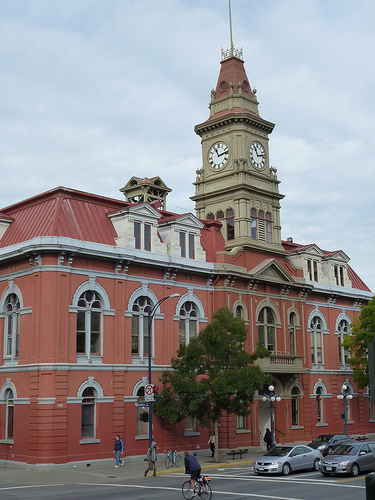
General view
© Parks Canada Agency / Agence Parcs Canada, Andrew Waldron, 2011.
Address :
1 Centennial Square, Victoria, British Columbia
Recognition Statute:
Historic Sites and Monuments Act (R.S.C., 1985, c. H-4)
Designation Date:
1977-11-17
Dates:
-
1878 to 1890
(Construction)
-
1963 to 1963
(Significant)
Event, Person, Organization:
-
Roderick Finlayson (mayor)
(Person)
-
John Teague
(Architect)
Other Name(s):
-
Victoria City Hall
(Designation Name)
Research Report Number:
1977-57,TOWN HALLS
Plaque(s)
Existing plaque: 1 Centennial Square, Victoria, British Columbia
Victoria's first city hall was designed in 1875. The building was begun three years later and completed in 1890. The designer was John Teague, an Englishman long resident in Victoria, who was responsible for planning many of the city's early buildings. His city hall was conceived in the Second Empire style popular at the time with a typical mansard roof, tower and rich ornamentation. The building remains one of the best surviving examples of this style in western Canada.
Description of Historic Place
The Victoria City Hall National Historic Site of Canada is a two-and-a-half storey brick building designed in the Second Empire Style. Architectural elements including a prominent central clock tower, a mansard roof with dormers, and numerous decorative wall features, reflect the building’s intended stature as an enduring monument to civic pride. The formal recognition refers to the building on its lot.
Heritage Value
Victoria City Hall was designated a national historic site of Canada in 1977 because it remains one of the best surviving examples of public architecture in the Second Empire style in western Canada.
Victoria City Hall illustrates Canadians' longstanding desire to create landmarks as expressions of civic pride and optimism for the future. Built in three stages between 1878 and 1890 to defray costs, the building’s scale was justified through the accommodation it provided for a wide range of civic functions including council chambers, municipal offices, fire hall, public market and jail. A rear annex was added in 1963. The Victoria City Hall continues to affirm the vision of its builders, both as the seat of local government and as an enduring architectural landmark.
Source: Historic Sites and Monuments Board of Canada, Minutes, November 1977.
Character-Defining Elements
The key elements relating to the heritage value of this site include:
those architectural elements that convey the rich variety of forms, textures and ornamentation that characterise the Second Empire style such as the central clock tower and balconied main entrance, mansard roof and dormers, eave brackets, the articulation of the wall plane with quoins, pilasters, belt courses and round-headed window, and the polychromatic brickwork of the original exterior wall surfaces; surviving evidence of the original interior layout and ornamentation of main public spaces; the symmetrical exterior massing, with a prominent central tower that expresses the building’s role as a civic landmark and embodies the distinctive qualities of 19th-century public architecture in the Second Empire style.