Building 1090
Recognized Federal Heritage Building
Goose Bay, Newfoundland and Labrador
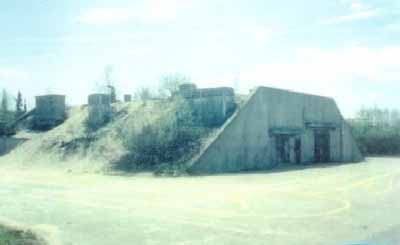
General view
(© Parks Canada Agency / Agence Parcs Canada.)
Address :
CFB Goose Bay / 5 Wing, Goose Bay, Newfoundland and Labrador
Recognition Statute:
Treasury Board Policy on Management of Real Property
Designation Date:
2004-07-15
Dates:
-
1953 to 1953
(Construction)
Event, Person, Organization:
-
Harold C. Knight
(Architect)
-
Fay, Spofford and Thorndike
(Builder)
Other Name(s):
-
Ammunition Bunker
(Other Name)
-
Nuclear Ammunition Bunker
(Other Name)
Custodian:
National Defence
FHBRO Report Reference:
98-134
DFRP Number:
01822 00
Description of Historic Place
Building 1090 of Canadian Forces Base (CFB) Goose Bay, also known as the Ammunition Bunker or Nuclear Ammunition Bunker, is a low profile, concrete bunker, set into earthworks. It possesses two poured-concrete end-walls, both equipped with a pair of asymmetrical vehicle doors, which give access to two large parallel rooms. The bunker is banked on either side with earth, and a group of vent stacks protrude in the grassed area above. The designation is confined to the footprint of the building.
Heritage Value
Building 1090 is a Recognized Federal Heritage Building because of its historical associations, and its architectural and environmental values.
Historical Value
Used for armament storage, Building 1090 is directly associated with the original function of the Goose Bay base as a part of the Strategic Air Command network, established to deter a Soviet attack on North America. As such, it constitutes a very good example of the theme of joint Canadian and American defense initiatives of North America during the Cold War. One of a group of six ammunitions bunkers, the first known structures intended for the storage of nuclear weapons in Canada, this building was used for the assembly of weapons, and is also associated with the first documented presence of nuclear armament on Canadian soil, an issue which later raised national interest and controversy. It was erected in the final phase of Goose Bay’s development during the Cold War.
Architectural Value
Designed for the American War Department by the engineering firm of Fay, Spofford and Thorndike, in collaboration with Harold C. Knight, architect, the building was intended first and foremost to serve specific functional requirements. Despite its primarily utilitarian military design, the structure does nevertheless possess an aesthetic and sculptural quality. The bunker’s good functional layout, and its sturdy permanent concrete structure, intended to withstand the harsh Labrador climate and potential enemy attacks, have endured well.
Environmental Value
By the nature of its function, the bunker was designed to disappear into its barren surroundings and still maintains this symbiotic relationship with the site. This concealment makes the structure compatible with the utilitarian military character of the air base, composed of sparsely placed clusters of large structures on a flat terrain. Although intentionally inconspicuous in appearance, the bunker has an iconic value and mythical significance through its historical associations.
Sources: Janet Collins, Consultant, Federal Heritage Buildings Review Office Report 98-134; Building 1090- Ammunition Bunker, CFB Goose Bay, Labrador, Heritage Character Statement 98-134.
Character-Defining Elements
The character-defining elements of Building 1090 should be respected.
Its aesthetic quality and good functional design, materials and craftsmanship, as manifested in: the asymmetrical end openings and the group of vent stacks protruding through the grassed surface of the berm, which bestow a sculptural quality to the overall exterior, the interior layout, consisting of two parallel rooms, accessible through either ends, which reflect the specific use of this bunker for weapons assembly; the use of poured concrete for the construction, which has ensured the permanence of the structure.
The building’s compatibility with the military character of the Goose Bay airfield and symbiotic relationship to the site as evidenced by: the manner in which the bunker has been concealed into a grassed berm; its location within a dispersed cluster of bunkers widely separated from the remainder of the base.
Heritage Character Statement
Disclaimer -
The heritage character statement was developed by FHBRO to explain the reasons for the designation of a federal heritage building and what it is about the building that makes it significant (the heritage character). It is a key reference document for anyone involved in planning interventions to federal heritage buildings and is used by FHBRO in their review of interventions.
Description of Historic Place
Building 1090 is a low profile, concrete bunker, set into earthworks. It possesses two poured-concrete end-walls, both equipped with a pair of asymmetrical vehicle doors, which give access to two large parallel rooms. The bunker is banked on either side with earth, and a group of vent stacks protrude in the grassed area above. The designation is confined to the footprint of the building.
Heritage Value
Building 1090 is a “Recognized” Federal Heritage Building because of its historical associations, and its architectural and environmental values.
Historical value:
Used for armament storage, Bunker 1090 is directly associated with the original function of the Goose Bay base as a part of the Strategic Air Command network, established to deter a Soviet attack on North America. As such, it constitutes a very good example of the theme of joint Canadian and American defense initiatives of North America during the Cold War. One of a group of six ammunitions bunkers, the first known structures intended for the storage of nuclear weapons in Canada, this building was used for the assembly of weapons, and is also associated with the first documented presence of nuclear armament on Canadian soil, an issue which later raised national interest and controversy. It was erected in the final phase of Goose Bay’s development during the Cold War.
Architectural value:
Designed for the American War Department by the engineering firm of Fay, Spofford and Thorndike, in collaboration with Harold C. Thorndike, architect, the building was intended first and foremost to serve specific functional requirements. Despite its primarily utilitarian military design, the structure does nevertheless possess an aesthetic and sculptural quality. The bunker’s good functional layout, and its sturdy permanent concrete structure, intended to withstand the harsh Labrador climate and potential enemy attacks, have endured well.
Environmental value:
By the nature of its function, the bunker was designed to disappear into its barren surroundings and still maintains this symbiotic relationship with the site. This concealment makes the structure compatible with the utilitarian military character of the air base, composed of sparsely placed clusters of large structures on a flat terrain. Although intentionally inconspicuous in appearance, the bunker has an iconic value and mythical significance through its historical associations.
Character-Defining Elements
The following character-defining elements of bunker 1090 should be respected:
Its aesthetic quality and good functional design, materials and craftsmanship, as manifested in:
- The asymmetrical end openings and the group of vent stacks protruding through the grassed surface of the berm, which bestow a sculptural quality to the overall exterior,
- The interior layout, consisting of two parallel rooms, accessible through either ends, which reflect the specific use of this bunker for weapons assembly;
- The use of poured concrete for the construction, which has ensured the permanence of the structure.
The building’s compatibility with the military character of the Goose Bay airfield and symbiotic relationship to the site as evidenced by:
- The manner in which the bunker has been concealed into a grassed berm;
- Its location within a dispersed cluster of bunkers widely separated from the remainder of the base.