Pleasantville-Building 223
Recognized Federal Heritage Building
St. John's, Newfoundland and Labrador
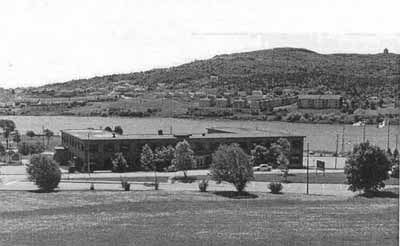
General view of the place
© Public Works and Government Services Canada/Travaux publics et Services gouvernementaux Canada, 2000.
Address :
2231 Legion Street, Pleasantville / Fort Pepperrell, St. John's, Newfoundland and Labrador
Recognition Statute:
Treasury Board Policy on Management of Real Property
Designation Date:
2000-09-29
Dates:
-
1955 to 1956
(Construction)
Event, Person, Organization:
-
O’Connor & Kilham, Praeger-Kavanaugh Eggers and Higgins, New York
(Architect)
Other Name(s):
-
Building 223
(Other Name)
Custodian:
Public Works and Government Services Canada
FHBRO Report Reference:
00-052
DFRP Number:
00373 00
Description of Historic Place
Pleasantville-Building 223 is a permanent headquarters building for Pepperrell Air Force Base, an American military base originally known as Fort Pepperrell. It is located within the community of Pleasantville on the north shore of Quidi Vidi Lake near the main base entrance. It is a two-storey, flat roofed, U-shaped, red brick structure built in 1955-56. It exhibits low, horizontal massing. The designation is confined to the footprint of the building.
Heritage Value
Pleasantville-Building 223 is a Recognized Federal Heritage Building because of its historical associations, and its architectural and environmental value.
Historical Value
Pleasantville-Building 223 is associated with American military bases on Canadian soil during the Cold War and also the continuing postwar expansion of federal government services. During this period, Pepperrell Air Force Base became the headquarters for the Northeast Air Command, the organization responsible for U.S. air defence of the North Atlantic. Pleasantville-Building 223 was one of several administration and operational buildings constructed at Pepperrell during this period. The base was abandoned by the United States in the 1950s and was bought by the Canadian government.
Architectural Value
Pleasantville-Building 223 is a modest but solidly constructed example of the modern movement that influenced the design of government and commercial buildings during the 1950s. The reliance on the modern style and the use of brick cladding were unusual in the Newfoundland context, and are indicative of the building’s U.S. military origins. The structure’s architectural significance lies in its contribution to the overall visual unity of the Pleasantville complex.
Environmental Value
The ongoing relationship of Pleasantville-Building 223 to its location, a flat, open, unadorned site near the main base entrance which emphasizes its position as a permanent headquarters building. Pleasantville-Building 223 is compatible with the 1950s military character of the military base setting and is conspicuous to those familiar with the base.
Sources: Don MacDonald, Pleasantville-Building 223 , Legion Avenue, Pleasantville, St. John’s, Newfoundland. Federal Heritage Building Report 00-052; Building 223, Legion Avenue, St. John’s, Newfoundland. Pleasantville Heritage Character Statement 00-052.
Character-Defining Elements
The character-defining elements of Pleasantville-Building 223 should be respected.
The modern design and good quality materials and workmanship, for example: the aesthetic characteristics which link it to the modern style, including the long, low profile of the building, the surrounding open space, the absence of applied ornamentation, the flat roof with extended soffits, and the extant parapets located above entrances; the red brick cladding associated with U.S. military construction.
The manner in which Pleasantville-Building 223, on its flat unadorned site, is compatible with the military character of Pleasantville and is conspicuous to those familiar with the base as evidenced by: its scale, materials and functional, modern appearance, all of which are sympathetic to the other buildings in the complex; its visible location from the main base entrance and red brick exterior that makes it a familiar point of reference within the base.
Heritage Character Statement
Disclaimer -
The heritage character statement was developed by FHBRO to explain the reasons for the designation of a federal heritage building and what it is about the building that makes it significant (the heritage character). It is a key reference document for anyone involved in planning interventions to federal heritage buildings and is used by FHBRO in their review of interventions.
Building 223 was constructed in 1955-56 by the United States Army Corps of Engineers as the new headquarters for Pepperrell Air Force Base, an American military base originally known as Fort Pepperrell. It was one of five U.S. bases established by the colonial Newfoundland government during World War Two on land granted under 99-year leases. Building 223 was designed by O=Connor & Kilham, Praeger-Kavanaugh Eggers and Higgins, a New York architectural and engineering firm contracted for expansions to the base in the 1950s. Extensive renovations were made to the interior of Building 223 in 1963-64, 1978, 1988 and 2000. Exterior changes have included the addition of a loading dock, the installation of a wheelchair ramp, and the replacement of the windows in 1988, the roof in 1992, and the main entrance canopy in 2000. The present custodian is Public Works and Government Services Canada. The occupant is Human Resources and Development Canada.
Reasons for Designation
Building 223 has been designated ARecognized@ because of its historical, architectural and environmental significance.
Historical Significance
Building 223 is associated with the continuing presence of U.S. military forces in Newfoundland after Confederation and with Canada=s awkward relationship with the U.S. during the Cold War. During this period, Pepperrell became the headquarters for the Northeast Air Command, the organization responsible for U.S. air defence of the North Atlantic. Building 223 was one of several administration and operational buildings constructed at Pepperrell during this period.
Architectural Significance
In its scale, massing, and detailing, Building 223 is a modest but solidly constructed example of the Modern movement which influenced the design of government and commercial buildings during the 1950s. The horizontality of the structure, its location on an expansive lot, the absence of applied ornamentation, the extended soffits of the flat roof, and the placement of flat canopies over the entrances, mark the building=s connection with the Modern Style. Both the reliance on the Modern Style and the use of brick cladding were unusual in the Newfoundland context, and are indicative of the building=s U.S. military origins.
Environmental Significance
The location of Building 223 near the main base entrance emphasizes its position as a permanent headquarters building. The carefully planned base included wide avenues and curvilinear street patterns common to American suburbs of the 1950s. The demolition of many Pleasantville buildings has eroded the intentions of its original designers, although the curving streets and wide open spaces remain.
Character-defining Elements
The heritage character of Building 223 resides in the following character-defining elements:
The aesthetic characteristics which link it to the Modern Style, including the long, low profile of the building, the surrounding open space, the absence of applied ornamentation, the flat roof with extended soffits, and the extant parapets located above entrances.
- The brick cladding associated with U.S. military construction.
- The placement of Building 223, set back slightly from the road on a flat, open, unadorned lot, within a curvilinear street plan, and near to the main base entrance.
All maintenance and repair work, as well as future interventions, should respect these character-defining elements.